Integrations Overview
7 min
The Integrations section in Sanoflow empowers businesses to connect various third-party applications and platforms to streamline operations. These integrations span messaging services, payment gateways, hospital management systems (HMS), and eCommerce solutions, among others.
What's on the Integrations feature?
Connected Channels
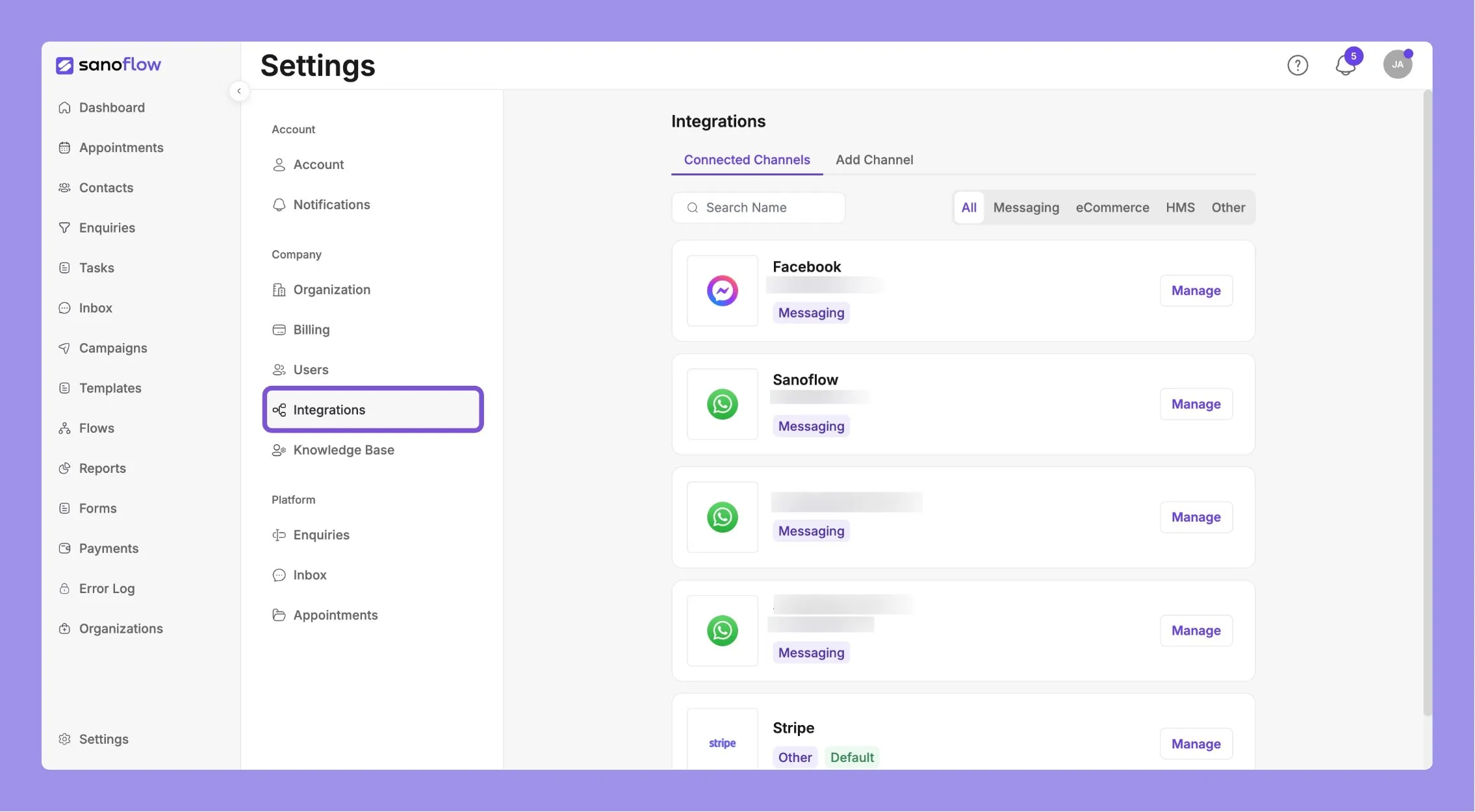
The Connected Channels tab lists all active integrations. Each integration is categorized under sections like Messaging, eCommerce, HMS, or Other. Key details include:
- Integration Name
- Category
- Manage button to modify configuration or remove the integration.
Example Integrations:
Add Channel
The Add Channel tab allows users to browse and add new integrations. Each integration is categorized and listed with a brief description.
Categories:
- eCommerce: @sallaSalla (eCommerce store management).
Steps to Add a New Integration:
- Go to the Add Channel tab.
- Select the desired integration and click Add.
- Provide the required credentials and configuration details (e.g., API keys, usernames, passwords).
- Click Save to activate the integration.
Practical Use Cases
- Customer Messaging Hub:
- Use WhatsApp Cloud API or Facebook to consolidate customer communications into one unified inbox.
- Automate responses with workflows for quicker resolutions.
- Streamlined Payment Processing:
- Leverage Stripe or ClickPay to handle online payments efficiently and securely.
- Optimized Appointment Scheduling:
- Integrate with Practo or other HMS systems to sync appointments and medical records.
- E-Commerce Integration:
- Connect Salla to automate order tracking, abandoned cart recovery, and customer notifications.
- Enhanced Task Management:
- Use Google Calendar integration to align appointments and team schedules in real-time.
Best Practices
- Audit Regularly:
- Periodically review connected channels to ensure all integrations are active and working as intended.
- Secure Credentials:
- Use strong passwords and keep API keys confidential. Update credentials periodically.
- Test Before Launch:
- Test integrations after setup to verify seamless functionality.
- Monitor Performance:
- Use reports to assess the efficiency of messaging and payment integrations.
- Stay Updated:
- Regularly check for updates in the integrations section to leverage new features or enhancements.
- Backup Configurations:
- Maintain a backup of integration configurations to avoid disruptions during troubleshootin
FAQs
- How do I add a new integration?
- Navigate to the Add Channel tab, select your desired integration, click Add, and provide the required details to activate it.
- Can I remove an integration?
- Yes, go to the Connected Channels tab, click Manage for the specific integration, and select Remove.
- What if an integration stops working?
- Check the credentials and reconfigure the integration if needed. If issues persist.
- For Instagram and Facebook specific integration problems, visit here.
- Can I connect multiple integrations under the same category?
- Yes, you can connect multiple integrations if it's a messaging category. If it's an HMS integration you cannot add other than one integration. You also may only add one Callgear account.
- Is there a limit to the number of integrations I can connect?
- Yes, this will depend on the plan that you have purchased.
- How do I manage permissions for integrations?
- Permissions are managed within the User Roles section in Settings. Ensure users have access to the relevant sections.
- What happens if I update the API credentials?
- The integration may stop working until the updated credentials are saved. Always update credentials immediately to avoid disruptions.
- Can I test an integration before making it live for customers?
- Yes, it's recommended to test each integration after setup using internal workflows or test accounts to ensure it functions correctly before using it in live environments.
- Are integration logs or activity histories available?
- Some integrations log key activities, such as message delivery or payment attempts. These logs can typically be found in the relevant module (e.g., Inbox, Reports) depending on the integration type.
- Do I need technical knowledge to set up integrations?
- Not necessarily. Most integrations come with guided configuration fields and tooltips. However, some setups (like APIs or HMS systems) may require support from your tech team or vendor for credential access.