Pipelines
8 min
The Pipelines' board in Enquiries in Sanoflow is a dynamic tool designed to streamline the management of your enquiries and leads. By segmenting enquiries into distinct stages, Pipelines help you track and visualize the progression of customer interactions, ensuring no opportunities are missed. This feature serves as a cornerstone for businesses aiming to improve operational efficiency and customer engagement.
Getting Here
This module is available for managers, admins, and users with authorized access to Pipelines view.
Accessing the Pipelines view is simple:
- Within the Enquiries module, locate the Pipeline View option in the top-right corner to switch to Pipeline Mode.
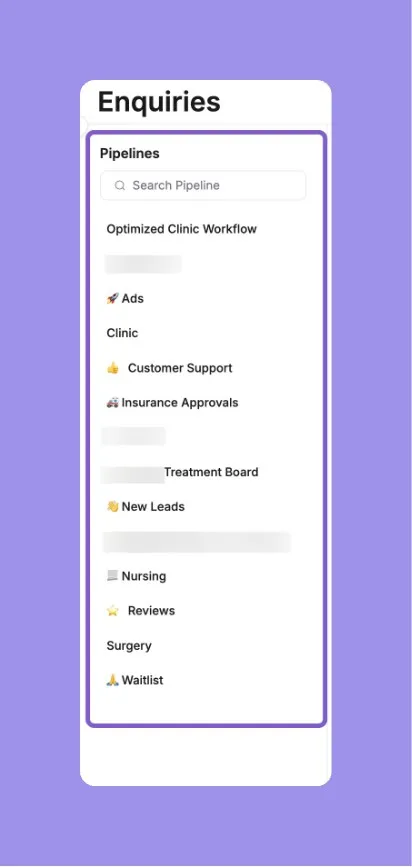
Pipelines are categorized based on workflows and can be customized to match your organizational structure.
Using Pipelines
Understanding Pipelines
A Pipeline consists of:
- Stages:
- Defined steps in your workflow where enquiries reside (e.g., New, Follow-Up, Qualified, Closed).
- Cards:
- Each enquiry is represented as a card, showing key details like the customer’s name, contact information, and the stage they’re in.
- Actions:
- Drag and drop cards between stages, update enquiry details, or perform quick actions directly from the card.
Customizing Pipelines
You can tailor Pipelines to match your business requirements:
- Adding Stages:
- Navigate your way to settings, and from the enquiries option in settings you will be able to add different stages.
- Rearranging Stages:
- Filters:
- Use primary and secondary filters to narrow down the enquiries displayed.
- Views:
- Toggle between predefined and custom views to quickly analyze specific subsets of data.
Key Notes for Pipelines
- Visibility:
- Only users with the appropriate permissions can modify or view certain pipelines.
- Bulk Actions:
- Perform bulk actions like assigning multiple enquiries, closing them, or adding tags from within the pipeline view.
- Custom Fields:
- Enquiries in pipelines can display custom fields like estimated value, assigned team, or service type, making them adaptable for diverse industries.
Practical Use Cases
- Sales Funnel Management:
- Organize leads by stages like “New,” “Contacted,” “Negotiation,” and “Closed” to streamline the sales cycle.
- Support Ticket Workflow:
- Track customer service cases from “New Request” to “In Progress” to “Resolved.”
- Appointment Scheduling:
- Manage patient or client appointments, from initial booking to follow-ups and completed sessions.
Best Practices
- Regularly review and update your pipeline stages to ensure they reflect current business processes.
- Use the drag-and-drop feature to quickly manage enquiries without leaving the pipeline view.
- Set up automatic notifications for stage transitions to keep your team informed in real time.
- Leverage analytics to identify bottlenecks in your workflow and optimize resource allocation.
FAQs
- Can I create multiple pipelines?
- Yes, you can create multiple pipelines in Sanoflow to reflect different workflows such as Sales, Support, or Appointments. Admins can do this in the Settings > Enquiries section.
- What is the purpose of the "Outside Working Hours" pipeline?
- This is typically used to automatically route enquiries that come in outside of set business hours. It helps prioritize follow-up and keep regular pipelines uncluttered.
- Can I rename or delete an existing pipeline?
- Yes, pipelines can be renamed or deleted from the Settings panel under the Enquiries tab. However, only admins can perform these changes.
- Can I control which users can see or access certain pipelines?
- Yes. Permissions for pipelines are role-based. Admins can set view/edit permissions for each pipeline depending on user roles or teams.
- How do I move an enquiry between pipelines?
- Currently, enquiries are bound to the pipeline they were created in. To move it, you must recreate it manually in the correct pipeline or update its attributes to match routing rules (if flows are used).
- Can I create automation rules based on pipeline stages?
- Yes. With the Flows module, you can trigger automations (e.g., notifications or task assignments) when an enquiry enters a specific stage.
- What are some use cases for pipeline-specific workflows?
- Sales (Lead > Contacted > Proposal > Closed), Appointment Scheduling (Booked > Follow-up > Attended), or Internal Review (New > In Review > Completed).
- How do I change the stage order in a pipeline?
- Go to Settings > Enquiries > Pipelines, then drag and drop the stages to rearrange them in the desired order.
- How do I change which fields appear on the enquiry card?
- Navigate to Settings > Enquiries > Pipelines, then edit the field layout under the respective pipeline. You can choose which fields show on each card preview.
- Can I view pipeline metrics or analytics?
- Yes. Pipeline activity is reflected in the Reports module. You can also export data by stage to analyze performance manually.